It is not only the Europe of grand boulevards, of cafés in the late afternoon, of libraries in which a single lamp burns patiently through the winter. Nor only the elegance of dress, nor the refinement of manners, nor the particular cadence of a conversation carried on at a table where no one is in a hurry.
It is something deeper, and less easily named.
It is the inheritance of a world that believed, almost without needing to say so, in beauty as a shared language; in continuity with the past; and in a meaning embedded, quietly and without announcement, within the very fabric of its culture.
That world did not simply fade. It collapsed — violently, in the course of a single generation — in the first half of the twentieth century. What remained, in its place, was not only ruin, but a silence where a certain way of seeing had once lived.
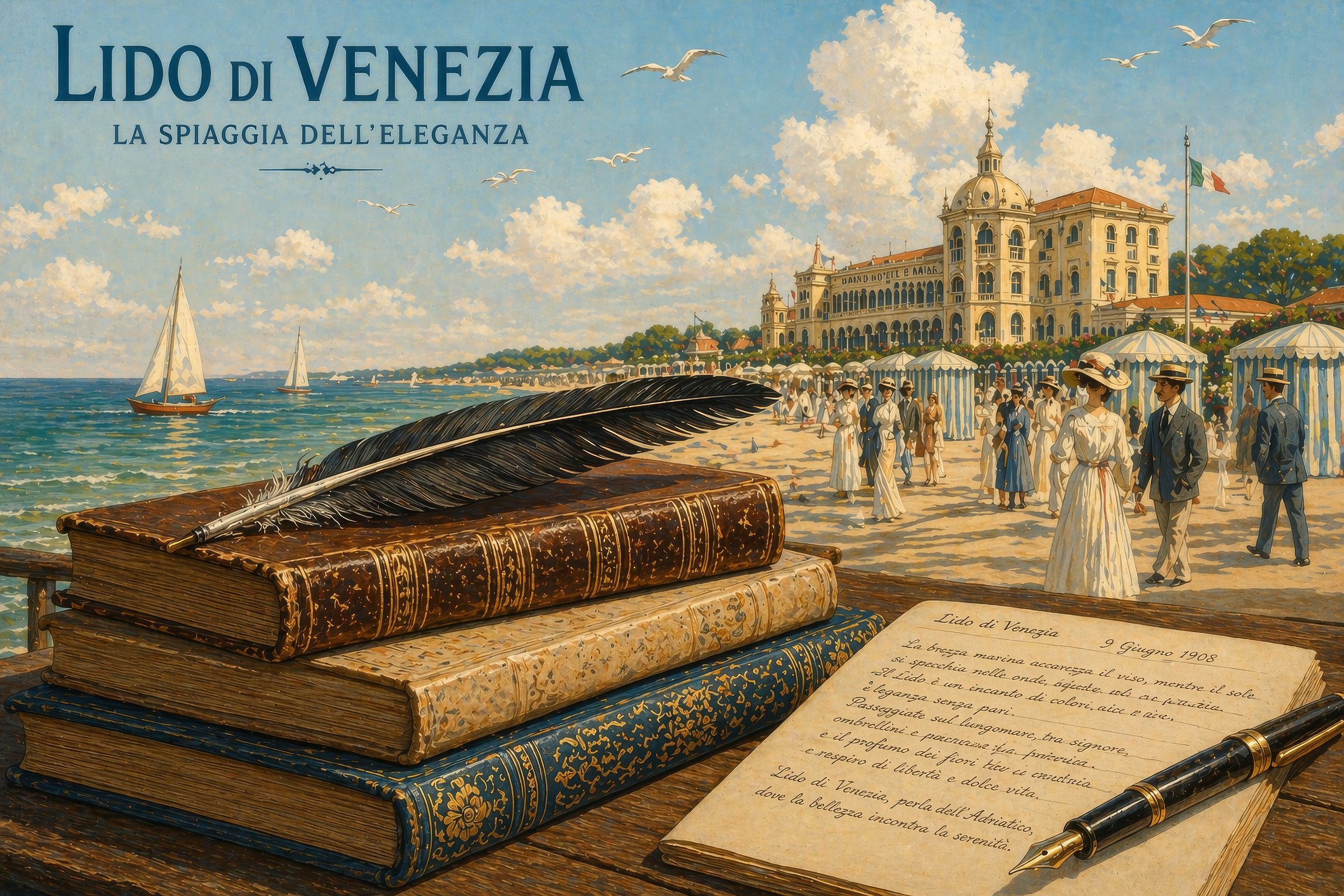
In Death in Venice, taken from the story by Thomas Mann, that world appears for a moment still intact — luminous, fragile, already on the edge of its disappearance. The quiet of the Lido in the last summers before the war. The bathing pavilions. The great hotels drawn up along the shore. A civilization observing, half knowingly, the hour of its own dusk.
It is this atmosphere — of beauty, of stillness, of a quiet awareness of transience — that informs the spirit of Lido House Editions.
Lido House Editions is devoted to works that resonate with this lost sensibility:
- Carefully adapted editions of traditional tales, carried into English not by literal translation, but by the kind of ear that listens for what a work, in its own tongue, was trying to say.
- Literary works of enduring value that have fallen quietly out of print.
- Contemporary writing that remains faithful, in aesthetic and in moral imagination, to the fin‑de‑siècle Europe whose air still travels, however faintly, to those who care to breathe it.
We are not bound by period, but by spirit. What matters is not when a work was written, but whether it belongs — intuitively, unmistakably — to that world.
A literary imprint devoted to the recovery of European texts and sensibilities — including, among its forms, carefully illustrated editions for younger readers.
This is, by intention, a modest endeavor.
We do not claim to define or to own this vision, nor to stand apart from others who have been drawn to it. We see our work, rather, as a small contribution to a longer and ongoing act of remembrance — a shared effort, among those who care, to preserve and to rearticulate a cultural inheritance that continues to speak, quietly, across the interval of time.
In an age that often favors speed over reflection, and novelty over continuity, we believe there remains a place — a small, necessary place — for books that offer something else:
- stillness,
- depth,
- and a sense of belonging to a longer story than the one of the present hour.
Lido House Editions exists to make such works visible again, and to give them a form worthy of the world they evoke.
Books from a world that has vanished,
yet continues to shape how we remember beauty.